

Last updated: October 7, 2026
What should you do when the housing market stops moving—but everything around it keeps changing?
That is the unusual position many Canadian homeowners find themselves in this fall.
According to the Canadian Real Estate Association’s August 2026 national housing statistics, home sales decreased just 0.7% from July, while the national MLS® Home Price Index was unchanged month over month. Monthly sales and price trends have now remained largely stable since May. CREA Stats
On the surface, Canada appears to be in a flat housing market.
But flat does not mean predictable.
New listings increased.
Year-over-year sales remained lower.
The Bank of Canada held its policy rate at 2.25%, while higher bond yields had already placed upward pressure on fixed mortgage rates. Bank of Canada
And broader economic, trade and inflation risks remain elevated.
That means homeowners should be careful about confusing:
stable prices
with:
stable conditions.
They are not the same thing.
The Short Answer: Is Canada’s Housing Market Recovering?
Not decisively.
Canada’s resale housing market has largely been moving sideways since late spring.
In August 2026:
- home sales declined 0.7% month over month;
- actual sales were 6.9% below August 2025;
- new listings increased 3.3% from July;
- the sales-to-new-listings ratio eased to 49.1%;
- months of inventory remained at 4.8;
- the national MLS Home Price Index was unchanged from July and 3.0% lower year over year; and
- the average sale price was $668,219, 0.6% higher than a year earlier. CREA Stats
That is not a conventional rebound.
It is closer to a holding pattern.
For additional context on affordability, interest rates and national pricing, see our broader Canada housing market update for 2026.
Canada Housing Market: August 2026 Snapshot
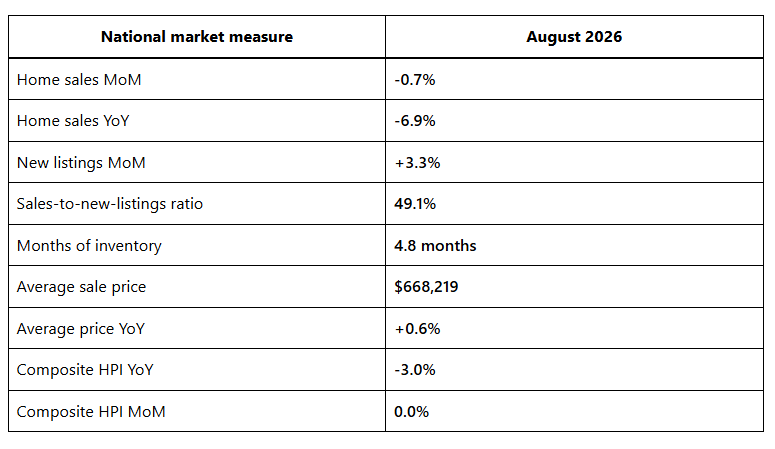
The table tells an important story.
Activity is subdued.
Inventory remains balanced nationally.
Prices are showing relatively little monthly movement.
But that does not mean every measure of value is telling exactly the same story.
Why Can Average Home Prices Rise While the Benchmark Falls?
This is one of the easiest Canadian housing statistics to misunderstand.
The national average sale price increased 0.6% year over year in August.
The national composite MLS Home Price Index was 3.0% lower.
Neither measure is necessarily wrong.
They measure different things.
The average sale price is heavily influenced by what types of homes—and which geographic markets—happened to transact during the month.
If proportionately more expensive homes sell, the national average can increase even when underlying values are softer.
The MLS HPI is designed to reduce some of that mix distortion by following the value of a representative property.
For homeowners, the takeaway is straightforward:
Never make a major real-estate decision based on one national price statistic.
Your property does not automatically rise because the national average increased.
And it does not automatically fall because a national benchmark declined.
Is Canada’s 4.8 Months of Inventory a Balanced Market?
Nationally, yes.
Canada had just under 200,000 residential properties listed across MLS systems at the end of August. That was only about 1.4% above the previous year and broadly consistent with typical seasonal levels.
Months of inventory remained at 4.8 months for the fourth consecutive month.
CREA’s long-term average is approximately five months. Readings below roughly 3.6 months tend to signal seller-favouring conditions, while readings above roughly 6.4 months tend toward buyer-favouring conditions. Storeys
But this statistic has a major limitation:
There is no single Canadian housing market.
Ottawa, Toronto, Calgary, Vancouver, Montréal and Halifax can all experience materially different supply-and-demand conditions at the same time.
National numbers provide economic context.
They do not determine what your house is worth.
The Bigger Signal: Listings Rose While Sales Slipped
August’s most notable change occurred on the supply side.
New listings increased 3.3% from July.
Sales declined 0.7%.
That combination pushed the national sales-to-new-listings ratio from 51.1% in July to 49.1% in August. CREA Stats
That is still inside balanced territory.
But direction matters.
It tells us that new supply entered the market faster than buyers absorbed it during August.
For sellers, that can mean greater competition.
For buyers, that can mean more choice.
For both sides, it increases the importance of looking beyond a national headline.
Why Mortgage Rates Still Matter in a Flat Housing Market
At its September 2 decision, the Bank of Canada maintained its policy rate at 2.25%. Bank of Canada
That sounds like stability.
But a Bank of Canada hold does not mean every mortgage rate is frozen.
Variable mortgage rates are closely tied to lender prime rates, which are influenced by the Bank’s overnight rate.
Fixed mortgage pricing operates differently.
Government of Canada bond yields are an important influence on fixed mortgage rates, and CREA noted in its August housing release that higher bond yields had already contributed to increases in fixed mortgage rates. CREA Stats
So homeowners can simultaneously experience:
- flat home prices;
- an unchanged Bank of Canada policy rate; and
- changing mortgage costs.
That distinction matters when deciding whether to sell, refinance, renew or purchase another home.
What CMHC’s 2026 Outlook Says About the Market
CMHC’s 2026 Housing Market Outlook Mid-Year Update remains cautious.
CMHC expects housing activity to remain subdued through 2026 as:
- slow population growth;
- high borrowing costs;
- modest income growth; and
- economic uncertainty
continue to constrain housing demand.
It expects home sales to recover gradually rather than rapidly, while national prices are expected to face downward pressure in 2026 before returning to modest growth later in the forecast period. CMHC
That is a forecast.
It is not a guarantee.
But it reinforces an important point.
There is currently little reason for homeowners to build a financial plan that requires an immediate nationwide housing surge.
There is also little reason to assume every region is experiencing a collapse.
A more defensible approach is scenario planning.
The Homeowner Decision Framework
When conditions are uncertain, homeowners often ask:
“Should I sell now, or wait until the market gets better?”
That question is incomplete.
I would evaluate four things instead.
1. Your Time Horizon
If you have no reason to move for another five years, monthly market fluctuations may matter very little.
If you are likely to move within six to eighteen months, today’s equity, financing, competing inventory and replacement-home costs matter considerably more.
Time horizon changes the relevance of market timing.
2. Your Next Transaction
Most homeowners do not simply sell.
They sell and then do something else.
If your next property is also located in a softer market, waiting for your existing home to increase in value may simply mean paying more for your replacement property later.
The number that matters is therefore not only:
What will my house sell for?
It is also:
What is the financial spread between the home I own and the home I want next?
That often produces a much better answer.
3. Your Financing Position
Understand:
- your existing mortgage rate;
- renewal date;
- remaining amortization;
- mortgage portability;
- prepayment penalties;
- qualification for the next mortgage; and
- how different rates could affect your future monthly payment.
The housing decision and mortgage decision should be analyzed together.
4. Your Local Market
This may be the most important factor.
National statistics should tell you what questions to ask.
They should not tell you what your individual house is worth.
Your local:
- active inventory;
- absorption rate;
- comparable sales;
- property type;
- price range;
- buyer pool; and
- direct competition
will usually matter more to the outcome of your transaction.
Ottawa homeowners, for example, can face substantially different conditions depending on whether they own a detached home, townhome or condominium.
What Should Sellers Do in a Flat Housing Market?
A sideways market increases the importance of creating your own momentum.
When buyers do not feel pressured by rapidly increasing prices, a listing has to earn attention.
That means:
- pricing must be supported by evidence;
- photography and presentation must compete with other available homes;
- marketing needs to reach the appropriate buyer;
- likely objections should be anticipated;
- comparable listings should be monitored; and
- the negotiation strategy should exist before an offer arrives.
That is why understanding how Ottawa sellers can stay competitive as inventory rises matters more in a slower environment.
A seller should also establish decision points before listing.
For example:
What level of showing activity should we expect in the first seven to fourteen days?
What new evidence would justify adjusting price?
What evidence would justify holding?
What are competing listings doing?
Prepared sellers make decisions using predetermined evidence.
Reactive sellers are more likely to make emotional decisions after the property is already under pressure.
What Should Buyers Do in a Flat Housing Market?
Flat markets can be useful for financially prepared buyers.
There may be:
- more selection;
- more time for due diligence;
- fewer emotionally driven bidding situations; and
- greater negotiating flexibility on properties that have been sitting.
But flat home prices do not automatically mean affordability has improved.
Monthly ownership costs matter as much as purchase price.
Evaluate:
purchase price + mortgage payment + property taxes + condo fees where applicable + maintenance + expected ownership period.
A $20,000 discount does not automatically create a good purchase if the monthly cost remains unsuitable.
Buyers preparing to enter the market can also review our guide to buying a home in Ontario in 2026 for additional financing and affordability considerations.
Should Canadian Homeowners Wait for Lower Mortgage Rates?
Waiting exclusively for a particular future mortgage rate requires predicting financial markets.
That is not a robust strategy.
If rates decline, buyer competition may increase.
If rates increase, borrowing capacity may decrease.
If rates remain near current levels, housing markets may continue moving sideways.
A better approach is to model several realistic outcomes.
Scenario A
Move under today’s prices and financing conditions.
Scenario B
Home prices increase modestly while mortgage rates decline.
Scenario C
Home prices soften while borrowing costs increase.
Scenario D
Both home prices and mortgage rates remain relatively stable.
If your move still makes financial and lifestyle sense under several reasonable scenarios, the decision is much less dependent on predicting the market correctly.
What Could Slower Housing Construction Mean?
Resale housing is only one part of Canada’s housing picture.
According to CMHC’s August 2026 housing-start data, the six-month trend in national housing starts declined 1.3% from July to 244,149 units.
Actual year-to-date housing starts through August were 4% below the same period in 2025. CMHC
Housing starts do not directly predict resale home prices.
New projects can also take years to complete.
But today’s construction environment affects the amount and type of housing available in future years.
That is why short-term resale conditions and Canada’s long-term housing-supply problem should not be confused.
Frequently Asked Questions
Is the Canadian housing market going up or down in 2026?
Nationally, neither direction is dominant right now. Through August, monthly home sales and the MLS Home Price Index had been largely stable for several months. However, actual sales were 6.9% below August 2025 and the national composite HPI remained 3.0% lower year over year. CREA Stats
Is Canada currently a buyer’s market?
Not nationally. CREA’s August measures remained broadly consistent with balanced conditions: 4.8 months of inventory and a 49.1% sales-to-new-listings ratio. Individual cities, neighbourhoods and property types can be considerably tighter or softer. CREA Stats
Why are fixed mortgage rates changing if the Bank of Canada is holding rates?
Fixed mortgage rates are influenced substantially by Government of Canada bond yields and financial-market expectations rather than only by the Bank of Canada’s overnight policy rate. Variable mortgage pricing is more closely connected to lender prime rates. Crea Cafe Archive
Should I sell my house now or wait until 2027?
There is no universal answer. The decision should consider your local housing market, equity, mortgage position, next purchase, transaction costs and personal timeline rather than relying on a national price forecast.
Are Canadian home prices falling?
It depends on the measure. In August 2026, the national average sale price was 0.6% higher year over year, while the MLS Home Price Index was 3.0% lower. That is why homeowners should evaluate local comparable sales rather than infer their property’s value from one national statistic. CREA Stats
Is Canada’s housing market recovering?
There are signs of stabilization, but not yet a decisive national rebound. Sales and benchmark prices were largely unchanged month over month through August, while CMHC continues to expect subdued activity and only gradual improvement over the medium term. CREA Stats
Anna’s Perspective
When a housing market moves sideways for months, waiting can feel like the safest option.
But waiting is still a decision.
It exposes you to future changes in:
- mortgage rates;
- property values;
- inventory;
- the cost of your next home; and
- your personal circumstances.
The objective should not be to correctly predict the exact month Canada’s housing market changes direction.
It should be to determine whether your move works under more than one plausible future.
That is a much stronger way to make a real-estate decision in an uncertain market.
If you are considering selling, buying, downsizing or moving within the next year, speak with the Anna Alemi Real Estate Team about modelling the numbers around your current property, next purchase and financing before you commit.
— Anna Alemi
Sources and data note
National resale-market statistics are based on CREA’s August 2026 release, currently the latest available national monthly package as of October 7, 2026. CREA’s next national release is scheduled for October 16. Monetary-policy information reflects the Bank of Canada’s September 2 decision, and housing-outlook and construction data are from CMHC.